The church itself
Minoritenkirche Vienna: what to see
The Minoritenkirche in Vienna: its Gothic portal, the tower hit in two sieges, the Italian national church and the Last Supper mosaic, in one visit.
Book a seat in the Minoritenkirche ↗Quick answer
The Minoritenkirche is a French-Gothic church on Minoritenplatz in Vienna's first district, begun in the 1270s and finished around 1350 by the Minorite friars. Look for the carved main portal, the tower that lost its spire in two sieges, the hall of three equal aisles and the life-size Last Supper mosaic on the side wall. Today it is an active church, so concert visitors come as guests.
The church in brief
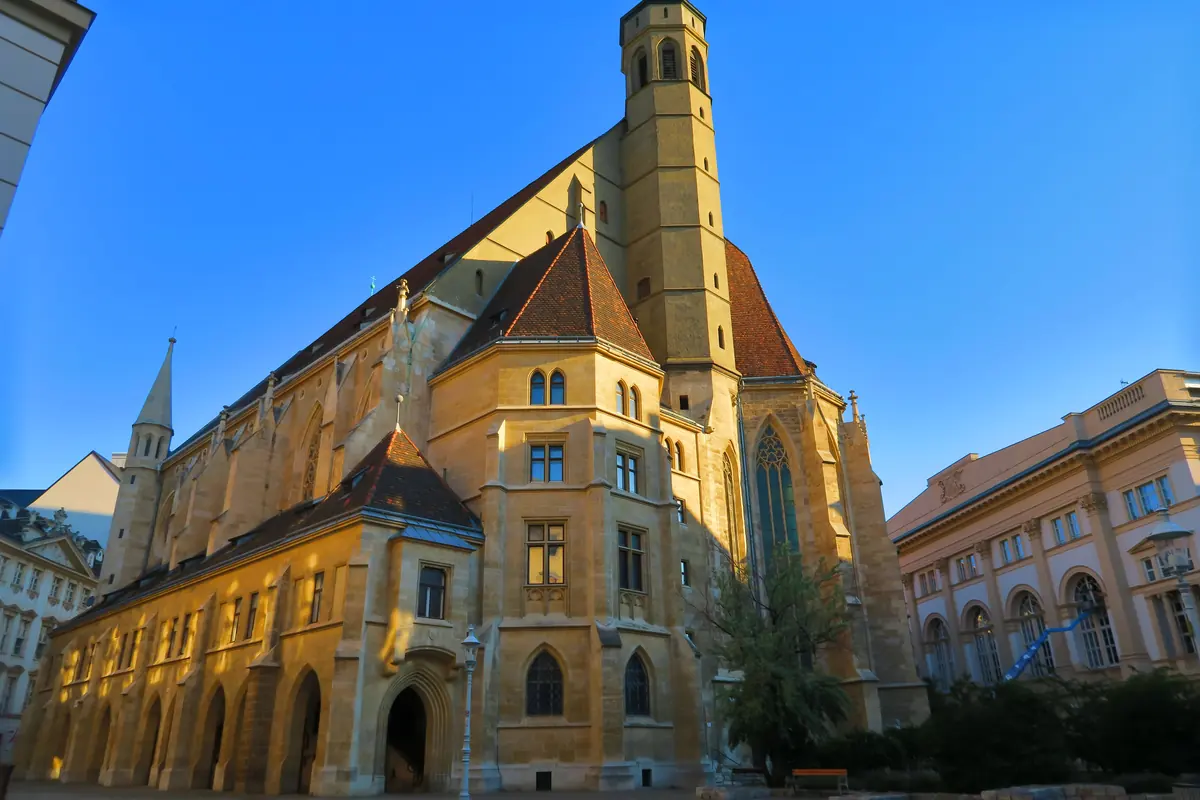
The Minoritenkirche stands on Minoritenplatz in Vienna's first district, the Innere Stadt. It was built by the Minorites, the Franciscan friars known in Latin as the fratres minores, in the French Gothic manner. It is one of the first Gothic churches in eastern Austria, and it still shows its medieval shape: a tall roof, a slender tower and a carved main portal. Its formal name is the Italian National Church of Mary of the Snows. That second name comes from a later chapter in its history, and the guide below follows both. Concert visitors enter as guests of an active church, so the building keeps its own rhythm of services around the evening.
The friars arrive
The Minorites were called to Vienna in 1224, and they built a small convent and a chapel near the new city wall. After city fires in the 1260s and 1270s, King Ottokar II of Bohemia laid the foundation stone of a larger church. The chapel was kept beside it and later enlarged. Between 1596 and 1620 the church served Protestant worship, while the friars kept saying Mass in rooms of their convent. The convent itself was pulled down from 1892, but the church has outlasted it. The church kept the name of the order long after the friars had left. The first chapel was consecrated in 1251 and later enlarged and rededicated to St Catherine.
A church built in stages
Construction ran for generations. The Ludwig choir, added to the east end, was built between 1316 and 1328 and served as a burial place in the 14th and 15th centuries. The main portal dates from about 1350, and the church is usually described as complete by then. The Ludwig choir was taken down in the 1780s rebuilding, and foundation walls of the long choir were found again when the underground railway was built in the 1980s. So the church you see is a medieval building with a missing end, and the missing end is part of its story. Medieval churches were often built in this piecemeal way, a nave first and a choir later. Duke Rudolf IV supported the rebuilding of church and convent between 1340 and 1400.
The main portal
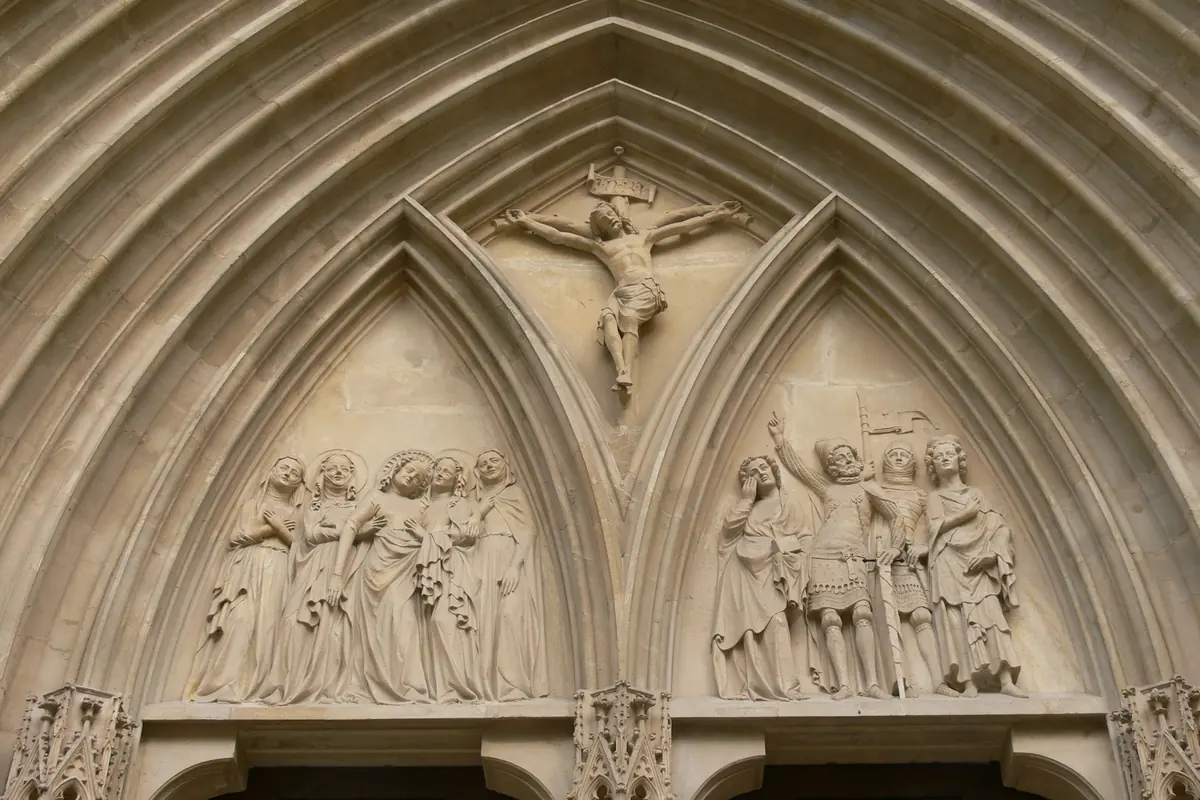
The central west portal, about 1350, is the best-known piece of medieval carving here. Its design follows a French pattern that is rare in Austria, and it is attributed to a friar called Jacobus Parisiensis, James of Paris. The tympanum carries a crucifixion with mourning women and a soldier, and figures stand in the jambs on both sides. The faces are slender and the drapery is fine, which is why art historians read it as French in style. If you only have time to look at one thing outside, look here. Art historians link the style to a Minorite workshop that was active until about 1360. On the central pillar stands the Virgin with her child.
The tower and the sieges
A tall, slender tower stands in front of the east end and now wears a low, flat roof. It did not always. In the first Ottoman siege of 1529 the defenders used the tower as a lookout, and Ottoman guns knocked the top off it. It was repaired in 1623 and lost its crown again in the second siege of 1683. Two cannonballs from those years were set into the wall above the main portal in 1875 as a reminder. Look up on the façade and you can still find them. The tower is slender and tall, and it is one of the easiest ways to pick the church out among the roofs of the first district.
The Italian national church
In the 1780s Emperor Joseph II moved the Minorite order to another building and gave the church to the Italian congregation in Vienna. They named it Maria Schnee, Our Lady of the Snows, after the altar picture they installed, a copy of a venerated image in Rome. The church was also reworked. Johann Ferdinand Hetzendorf von Hohenberg removed baroque fittings, pulled down the Ludwig choir and closed the east end with a flat vault. That explains why a church so medieval outside looks so plain and clear inside. The formal name Maria Schnee has stayed, though the Minoritenkirche is the name on the square. The priest Clemens Maria Hofbauer directed the church from 1808 to 1813.
Inside the hall
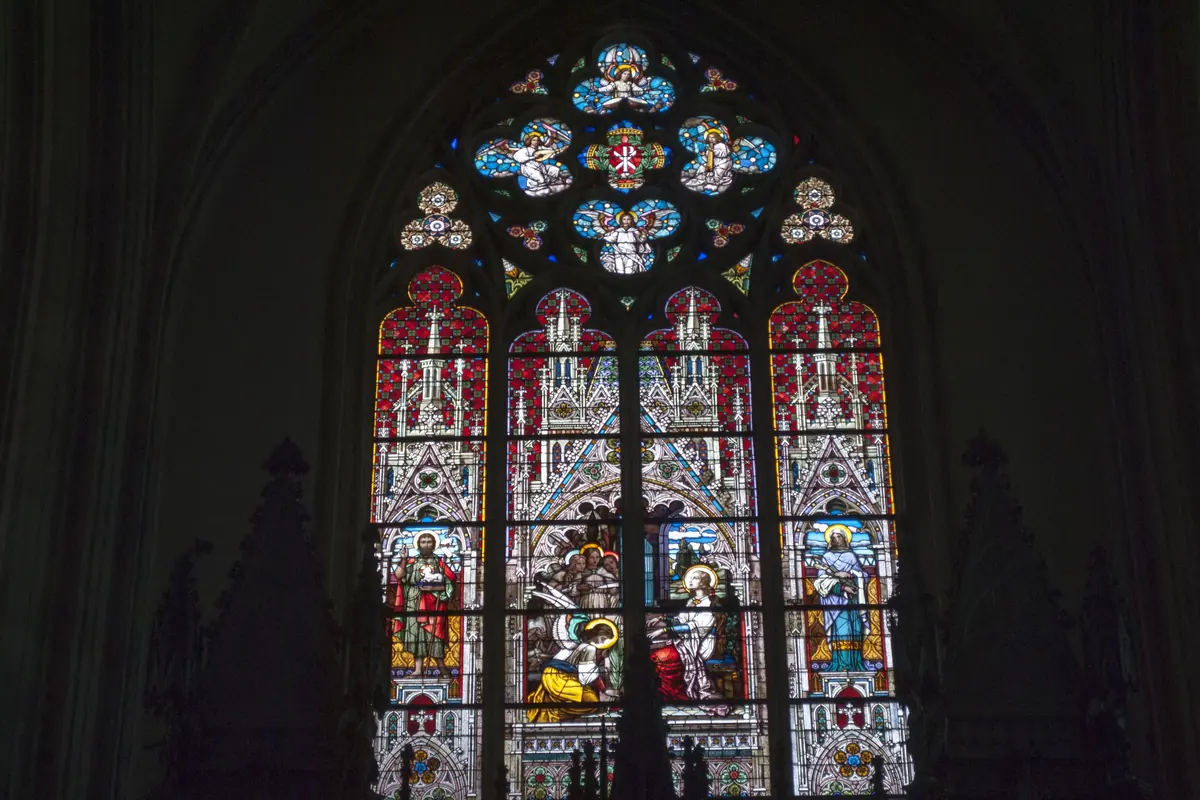
Inside is a hall church of three aisles of the same height, with ribbed vaults rising from clustered piers that have no capitals. Some of the traceried windows are medieval originals. A stone figure of the Virgin, the Madonna della Famiglia, dates from about 1350. The high altar is a neo-Gothic work by Hetzendorf. The walls carry painted coats of arms of noble families. It is a spare, tall space, and the stone gives it the resonance that concert-goers mention. Look up and follow the ribs of the vault from pier to pier. The altarpiece is a copy of the Maria Schnee image venerated in Santa Maria Maggiore in Rome.
The Last Supper mosaic
On a side wall hangs a life-size mosaic copy of Leonardo da Vinci's Last Supper, about 9 metres wide. It was made by the Roman mosaicist Giacomo Raffaelli under Napoleonic rule, finished only after Napoleon's fall, bought by the Austrian emperor and later given to this church. It was set up on the wall in the 1840s. It is the single most striking object in the building, and it has its own guide on this site, with the dates and dimensions in full. This page only points to it. Ferdinand I met the cost of setting it up.
Read next: The Last Supper mosaic in Vienna
The Metastasio monument
On the opposite wall stands a marble monument to Pietro Metastasio, the court poet of Vienna, by the sculptor Vincenzo Luccardi. Metastasio came to Vienna as court poet in 1729 or 1730 and died there in 1782. His libretti were set to music by many composers, which is why a poet's monument belongs in a church where concerts are now given. A relief on it is usually described as showing composers among the mourners, Mozart and Haydn included. The poet himself is buried in another Vienna church. The monument was erected in 1855. In the central relief, Pope Pius VI is shown blessing the dying poet.
Minoritenplatz and the way there
The square outside is one of the oldest public squares in Vienna. It is lined with palaces, and the Austrian State Archives stand at number 1. Small monuments on the square honour the painter Rudolf von Alt, the priest Clemens Maria Hofbauer and the politician Leopold Figl. The church is in the Innere Stadt, so most central hotels are a short walk or one short ride away. Plan your route with the city's public-transport route planner for the day you travel, and leave time to walk the square before the doors open. The square has its own guide on this site. The State Archives, founded in the 15th century, occupy a building of 1901.
Who this isn't for
This guide describes a church, and the booking is for a concert. If you want a guided historical tour of the building, this ticket is not it, because admission is for the concert alone and photography inside is not allowed. If you want to see the mosaic in daylight without a concert, check the church's own arrangements for visiting, because they are not part of this ticket. And if your interest is Gothic architecture alone, you may prefer a walking tour. If the concert is the point, the building comes with it. Visiting hours for the church are the church's own business, so ask there.
Frequently asked questions
What is the Minoritenkirche?
A Gothic church on Minoritenplatz in Vienna, built by the Minorite friars. Since the 1780s it has also been the Italian national church, Maria Schnee.
When was it built?
The foundation stone was laid in the 1270s, and the main portal dates from about 1350. The church is usually described as complete by then.
What is the mosaic?
A life-size mosaic copy of Leonardo's Last Supper by Giacomo Raffaelli, about 9 metres wide, on a side wall.
Why does the tower have a flat roof?
Its spire was destroyed in the Ottoman sieges of 1529 and 1683. A low flat roof replaced it after the second.
Is the church only a concert venue?
No. It is an active church, and the concerts are held there as guests.
Can I take photographs during the concert?
No. Photography inside, flash and video recording are not allowed at the concerts.
Sources