The music
Mozart, Haydn, Beethoven in Vienna
What a Vienna church-concert programme is made of: the First Viennese School, Vivaldi's Four Seasons, and the requiems of Mozart and Brahms.
Book a seat in the Minoritenkirche ↗Quick answer
A Vienna programme usually draws on three groups: the First Viennese School of Haydn, Mozart and Beethoven, Baroque favourites such as Vivaldi's Four Seasons, and seasonal or choral works such as requiems. The Minoritenkirche's programme changes with the date, so check the entry for your evening on the booking page before you choose.
Why Vienna and these composers
Three composers of the Classical period are tied to Vienna: Joseph Haydn, Wolfgang Amadeus Mozart and Ludwig van Beethoven. Musicologists call them the First Viennese School, a label coined by Raphael Georg Kiesewetter in 1834. Franz Schubert is sometimes added. They were not a school in the sense of a formal teaching group. Haydn and Mozart sometimes played chamber music together, and Beethoven took lessons from Haydn. The name stuck, and concert programmes in the city still lean heavily on their work.
Haydn, the elder
Haydn was born in 1732 and died in Vienna in 1809. He began as a chorister at St. Stephen's Cathedral, spent much of his working life as music director for the Esterházy family, and became the most celebrated composer in Europe. He is called the father of the symphony and of the string quartet, and that matters for a chamber concert, because the string quartet is the form you are most likely to hear in a church-sized room. He was a friend and mentor of Mozart and a teacher of Beethoven.
Beethoven in Vienna
Beethoven was born in Bonn and moved to Vienna at 21, where he studied composition with Haydn. He became known first as a virtuoso pianist and was soon supported by Prince Lichnowsky, whose patronage led to his three piano trios, the Op. 1 set of 1795. Vienna became his base for life. His chamber works, trios and quartets suit a small ensemble in a stone room. His music sits in the transition between the Classical and Romantic periods.
Vivaldi's Four Seasons
Vivaldi was Venetian, not Viennese, but the Four Seasons turns up often in Vienna programmes and appears in the Minoritenkirche's. The four violin concertos were composed around 1718 to 1723 and published in Amsterdam in 1725. Each has a sonnet attached, which makes them an early example of programme music: you can follow the storm, the barking dog and the frozen landscape in the notes. Vivaldi himself moved to Vienna late in life, hoping for royal support, and died there in 1741.
Two requiems
Some Minoritenkirche dates feature a requiem for choir and orchestra. Mozart began his in Vienna in late 1791 and left it unfinished when he died on 5 December that year. Joseph Eybler and then Franz Xaver Süssmayr completed it. Brahms's A German Requiem is a different work: it is set in German, not Latin, is sacred but not tied to the church service, and lasts 65 to 80 minutes. Its first partial performance took place in Vienna on 1 December 1867 and went badly because of a timpani mistake.
The poet on the wall
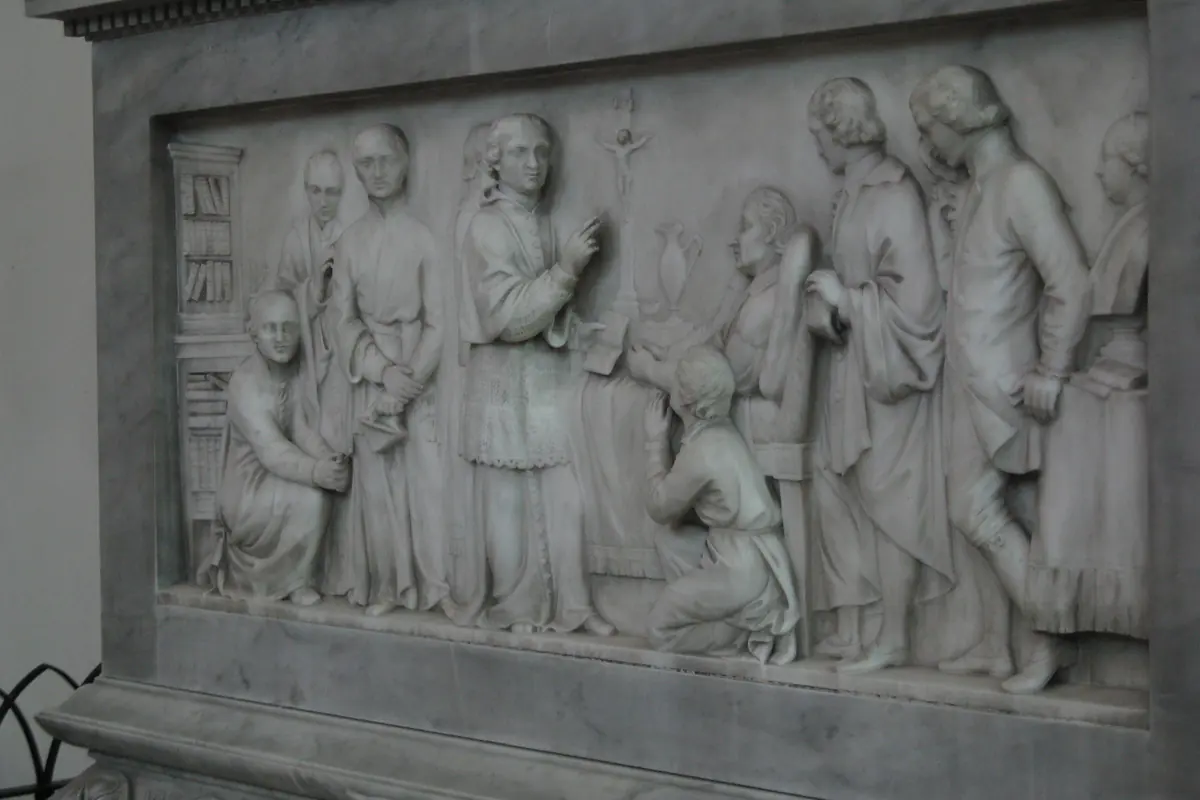
The church holds a monument to Pietro Metastasio, who was court poet in Vienna from 1729 and died there in 1782. Composers set his libretti by the dozen: his Adriano in Siria alone was set by more than 60 of them. Mozart used an older Metastasio libretto, substantially rewritten, for La clemenza di Tito. The relief is usually described as showing Mozart and Haydn among those gathered round the dying poet. Whether or not you recognise the faces, the monument ties the church to the world of Viennese opera.
Read next: Minoritenkirche Vienna: what to see
Chamber evening or choral evening
Choose by format. A chamber evening, such as a string quintet or a cello ensemble, is intimate and plays well in a Gothic nave. A choral evening with orchestra, such as a requiem, is larger and more solemn, and the programme says so. Seasonal evenings at Easter, Advent, Christmas and the new year have their own mood. The booking page for each date names the performers and the pieces where they have been announced, so use it to decide, and treat the first two or three titles as the clue.
Who this isn't for
If you want a particular famous work guaranteed on a particular night, a church concert with a changing programme may not suit. If you want opera staging, costume or a dinner, this is not the format. And if you dislike strings in a resonant room, a stone church will not change your mind. The programme is the variable here. The room, the Gothic vault and the mosaic, are the constants, so book it for the setting as much as for the score.
Frequently asked questions
Which composers are played?
Programmes name Vivaldi, Mozart, Beethoven and Haydn among others, with seasonal programmes at Easter, Advent, Christmas and New Year.
Will I hear the Four Seasons?
It appears among the programmes but not on every date. Check the entry for your date on the booking page.
Sources